Is the London Eye Better at Day or Night?
The wheel sells the same 30 minutes at every hour it operates, which means the only thing you are really choosing is what London is doing while you are up there.
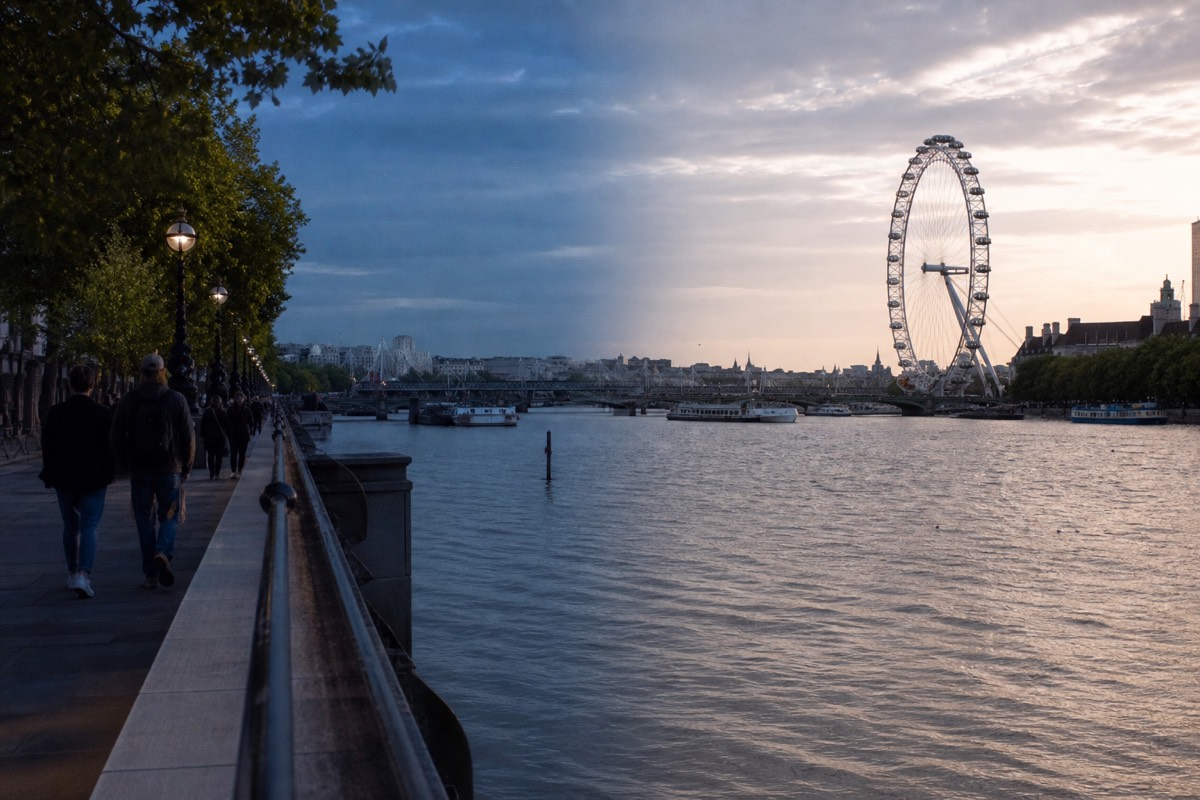
Short answer
Daylight wins on visibility: the operator states you can see up to 40 kilometres in all directions on a clear day, and every landmark is identifiable. Darkness wins on atmosphere, with the city lit and the river reflecting it. Golden hour just before sunset gets closest to both, and direct Eye admission lets you select a slot, while some combinations require a separate Eye reservation.
This question keeps appearing on its own, separately, in the answer engines: is it better to do the London Eye at day or night. Not "is it worth it", not "how much is it". Specifically day or night. That is a sign the wheel is unusual among viewpoints, because for most of them the answer is obvious. Nobody agonises about whether to visit a cathedral in the dark.
The reason it is a genuine question here is that the wheel sells you a slot, not an experience, and the two versions of the experience are very different views from the same attraction. One is a geography lesson with a 40 kilometre reach. The other is a lit city in a glass box. Both take about 30 minutes; prices depend on the date and ticket option, and the season you are visiting in may have already decided which one you are getting.
What do you actually see in daylight that you lose after dark?
Distance and identification. The operator states that on a clear day visibility from the wheel reaches up to 40 kilometres in all directions, which puts the outer edges of Greater London and the country beyond it inside the view. After dark you can see lights, not landscape, and anything unlit disappears entirely.
That 40 kilometre figure is the daylight case in a single number, and it is worth understanding what it contains. From 135 metres above the Thames, with almost nothing tall in the immediate foreground, the horizon is very far away and very unobstructed. The parkland to the west, the low sprawl to the south, the Thames estuary direction to the east: all of it is visible geography in daylight and all of it is black at night.
The operator's own visitor guide to the view names the landmarks it considers reliably identifiable, and the list is a good summary of what daylight buys.
| Landmark | Direction from the wheel | Daylight | After dark |
|---|---|---|---|
| Big Ben and the Houses of Parliament | Directly across the river, west | Fully legible, closest major landmark | Floodlit and one of the best night subjects |
| The River Thames | Runs through the whole view | The organising line of the whole panorama | Visible as reflected light only |
| Buckingham Palace | West, beyond St James's Park | Identifiable with the park around it | Hard to pick out, low and unlit |
| St Paul's Cathedral | East, downstream | Dome clearly visible above the roofline | Lit dome, still recognisable |
| Tower Bridge | Far east, downstream | Visible on a clear day | Lit, but small at that distance |
| The Shard | South east | Obvious, the tallest building in the country | Lit spire, a strong night marker |
| The Olympic Park | Far east | Visible on a clear day | Effectively invisible |
| The horizon at 40 kilometres | All directions | The whole point of a clear-day ride | Gone |
Daylight generally makes photography through the capsule glass easier because the city is brighter relative to the interior. Reflections can still appear depending on your angle, clothing and the light.
What does the London Eye look like at night?
Different in kind rather than degree. The operator describes the night view as city lights sparkling, reflections shimmering on the Thames, and an atmosphere that turns calm and cinematic. You lose the horizon and the geography lesson. You gain a lit river with lit bridges running through the middle of a dark city, which photographs and reads as a completely separate attraction.
The night version concentrates the view rather than expanding it. Everything that matters is close: the illuminated Palace of Westminster directly opposite, the bridges running downstream in a line of light, the office towers of the City and Canary Wharf as clusters, the Shard as a marker to the south east. The far distance simply is not there, and once you stop expecting it, that is not a loss so much as a reframing.
The operator’s day and night view page describes the appeal of illuminated landmarks after dark. Capsule occupancy still depends on demand; booking an evening slot does not buy a quieter or less crowded capsule.
The trade you make for it is precision. Someone visiting London for the first time who wants to understand where things are should ride in daylight. Someone who has already spent two days walking the city, and now wants to see it assembled and lit, should ride at night.
Is it better to ride the London Eye at night or day?
If it is your first visit to London, ride in daylight. If you already know the city, or if you want the version that photographs like a postcard, ride after dark. If you can get a slot in the hour before sunset, take that instead of either, because it delivers most of the daylight view and then hands you the transition.
The operator's own guidance says the same thing in fewer words: for clarity and daytime visibility go in the morning or early afternoon, and for atmosphere, sunset and the night view choose an evening ride. That is unusually honest for an attraction's own marketing, and it matches what the review pattern suggests.
Here is the side-by-side, since this is the decision the page exists to settle.
| Daytime ride | After-dark ride | |
|---|---|---|
| Visibility | Up to 40km in all directions on a clear day | Only what is lit, roughly the central few kilometres |
| Landmark identification | Every named landmark legible | Half the list disappears |
| Glass reflections | Minimal, glass close to invisible | Significant, interior light bounces back |
| Photography | Easy, no special technique needed | Harder, needs a steady hand and a lens against the glass |
| Weather dependency | Very high, haze or rain ruins the distance | Lower, lights read through light rain |
| Atmosphere in the capsule | Wider detail to identify | Focus on illuminated landmarks; occupancy varies |
| Best for | First-time visitors, families, orientation | Repeat visitors, couples, occasions |
| Winter availability | Limited, the useful daylight window is short | Wide, dark comes early |
| Summer availability | Wide | Limited in midsummer, when sunset can fall after closing |
That last pair of rows is the one people miss until it is too late, and it is the subject of the next section.
Does the season decide the answer for you?
Often, yes. Around midsummer, sunset can fall after the Eye has closed; in midwinter it falls during the afternoon. Opening and closing times vary by date, so compare the actual operating calendar with sunset rather than treating all warmer months alike.
The numbers make this concrete. Near 21 June, London sunset falls around 21:22, later than an illustrative 8.30pm closing. On 21 December, sunset falls at around 15:54, which is the middle of the operating day. The operating hours also change by date; an 8.30pm summer closing is an example, not a promise for every warmer-month day.
Two practical consequences follow from that chart. On summer dates when sunset falls after closing, choose daylight for the distant view. In December, leave enough time before sunset for the queue and rotation if daylight matters; a booked afternoon slot alone does not guarantee it.
The shoulder seasons are where you actually get to choose. In spring and autumn, sunset may overlap operating hours, but the overlap depends on the exact date and the slots offered. Detailed opening hours by season sit in the opening times guide, and they matter here more than they do for any other decision about the wheel.
When is golden hour on the wheel, and can you book it?
Golden hour is the hour or so before sunset, and the operator names it directly as the most rewarding time to ride. You can book it, because direct Eye admission offers a chosen queue-entry time; some combination tickets require a separate Eye reservation. The catch is that your slot is when you join the queue, not when you board, so a sunset slot needs booking earlier than the sunset itself.
That gap between slot and boarding is the single most useful mechanical fact on this page. The operator states plainly that the time you select is when you join the queue and that you cannot join before it. So if you want to be at the top as the light turns, you need to be in the queue with time to spare, not arriving as the sun touches the roofline.
Allow a generous window around sunset when selecting your queue-entry time, or consider fast track to reduce the boarding queue. Neither option guarantees the light at the top of the rotation: the queue, weather and actual boarding time still matter.
The 30-minute rotation can catch changing light if it overlaps dusk. Boarding a full hour before sunset, however, means finishing before sunset; choose a flexible window rather than expecting every evening booking to deliver both daylight and darkness.
Which is better for photography, day or night?
Daylight is easier and night is more striking. In daylight the glass is close to invisible and a phone camera handles the whole scene without help. At night the capsule's interior light reflects off the glass, exposures get long, and the wheel is still moving, so pictures need a lens pressed against the glass and a steady hand.
The physics are worth understanding before you decide, because "better photos at night" is a claim that only holds if you get the technique right.
The capsule glass is curved and there is interior lighting. At night that combination produces a bright reflection of the inside of the capsule layered over the city. The standard fix is to hold the lens flat against the glass so the reflection is excluded, which works but limits your angles. The secondary problem is motion: the wheel never stops, so a long exposure smears. That is not a large amount of movement at 26 centimetres a second, but it is enough at slow shutter speeds.
In daylight none of that applies. The exposure is short, the reflection is faint, and you can shoot from anywhere in the capsule. The pictures are less dramatic and much more reliable.
| Photography factor | Daytime | After dark |
|---|---|---|
| Reflections on the glass | Minimal | Significant, hold the lens flat against it |
| Exposure length | Short, handheld with no thought | Long, movement shows |
| Wheel motion | Irrelevant | The limiting factor on sharpness |
| Best subject | Wide panorama, the whole river | Westminster floodlit, bridges downstream |
| Reliability | High, most shots work | Low, a minority of shots work |
| Standout result | Rare, it is a nice view photo | Possible, the good ones are very good |
| Golden hour | The best of both, short window | The best of both, short window |
The best compromise is the same as the best compromise for looking, which tells you something: aim for a rotation that overlaps dusk, while allowing for the variable interval between queue entry and boarding.
How long are the wait times, and does the hour change them?
The operator advises that peak waits can reach 45 minutes after the booked queue-entry time; the actual wait varies. What is documented is the mechanism: your booked slot is when you join the queue, and entry typically stops 30 to 45 minutes before closing. Late-morning and midday slots on summer weekends carry the heaviest demand; first slots of the day and later evening slots are lighter.
Rather than guess at minutes, plan around the structure. There are two queues, security screening and boarding, and both have to clear before your capsule. A fast-track ticket shortens the second of those, which is the one that grows on a busy afternoon.
If your ride has to happen at a specific moment, for a sunset or an occasion, treat the queue as the risk rather than the price. The fast-track option on the main listing exists precisely for this, and it is more valuable on a July Saturday at five o'clock than it is at any other time of the week.
One further timing detail worth knowing: the wheel closes on Christmas Day and closes for a scheduled maintenance period in January. Anyone planning a winter night ride should check the calendar before booking flights around it.
Does the champagne upgrade change the day or night calculation?
It strengthens the evening case. The Champagne Experience is a 30-minute rotation with fast-track priority boarding, an Eye Lounge wait and a glass of real champagne, and like the standard ticket it lets you choose the slot. Pairing it with a sunset rotation is the strongest version of the product, and fast track reduces the boarding queue but does not guarantee a sunset rotation.
That is the practical argument for the upgrade on this specific page, separate from whether it is worth the money in general. A sunset slot is the one time of day where being stuck in a queue actively costs you the thing you booked for. Fast track can reduce that wait, and the Champagne ticket includes it.
Compare the Champagne price for your date with the standard and fast-track options. The upgrade pays for the host, lounge visit and drink as well as priority entry; the champagne experience guide explains those inclusions.
For a daytime ride the upgrade adds much less. The queue is usually shorter earlier in the day, there is no occasion framing to protect, and a glass of champagne at eleven in the morning is a different proposition.
Is the wheel worth it at night specifically?
Yes, but for different reasons than in daylight, and the value judgement changes with it. A night ride is the same length but a more concentrated visual experience: less to identify, more to look at. If you are weighing whether the ticket is worth the money at all, the honest answer depends more on weather and expectation than on the hour.
In light rain, illuminated landmarks can remain attractive, but cloud, heavier rain and reflections can still obscure them. An after-dark ride trades distant detail for nearby lights; it does not remove the weather risk.
If your priority is the distant skyline, choose a clearer forecast and a daylight slot when possible. Choose after dark for atmosphere rather than as insurance against poor visibility.
The broader value question, whether the ticket earns its price at any hour, is covered in the is it worth it verdict, which works through the real review data rather than the marketing.
So which slot should you actually book?
Book the hour before sunset if the season allows it. Failing that, book a morning slot for a first visit to London and an evening slot for a repeat visit. Choose after dark for atmosphere, not weather protection. Fast track reduces waiting but does not guarantee precise boarding.
That is the whole decision in four lines, and the order matters. The sunset slot is genuinely better than either pure version, which is why the operator, the photographers and the reviews all converge on it. Its availability depends on sunset, date-specific operating hours and the offered slots.
Everything else follows from what you are there for. Orientation wants daylight. Atmosphere wants darkness. Poor weather can affect either view. An occasion may justify a hosted upgrade and a flexible evening window.
The ride remains the same 32-capsule wheel, 135 metres high, with an approximately half-hour rotation. You choose a queue-entry slot; weather, waiting time and actual boarding determine the view you receive.
Frequently asked questions
Is it better to do the London Eye at day or night?
Daylight for a first visit, because visibility reaches up to 40 kilometres on a clear day and every landmark is identifiable. After dark for a repeat visit or an occasion, because the lit city and the reflections on the Thames make a different and more atmospheric experience. Golden hour just before sunset gets closest to both.
Is the London Eye worth it at night?
Yes, if illuminated landmarks are your priority. Poor visibility, rain and reflections can affect night views too. What you give up is the distance view and half the landmark list, since anything unlit is invisible.
Can you ride the London Eye after dark in summer?
Around midsummer, sunset can fall after closing, so an evening ride may still be in daylight. Compare the actual closing time with sunset for your date; spring, autumn and winter can offer different overlaps.
What is the best time of day for photographs?
The hour before sunset. Daylight gives you easy exposures and almost no reflection off the capsule glass, night gives you the striking images but needs a lens held flat against the glass to kill the interior reflection. A rotation overlapping dusk may catch both views; the queue-entry time does not guarantee that overlap.
How long are the wait times for the London Eye?
The operator quotes peak waits of up to 45 minutes after queue entry, with the actual wait varying by date and hour. What is documented is the structure: security screening and then a boarding queue, with your booked slot marking when you may join, and entry stopping 30 to 45 minutes before closing. Summer weekend afternoons are heaviest. Fast track can reduce the boarding queue but cannot guarantee an exact boarding time.
Choose Your London Eye Experience
Choose your visit date before fixing the rest of your London plans, then check the ticket option and queue-entry time.
London Eye Standard or Fast Track Ticket. A 30-minute rotation. Choose standard or fast-track boarding; security and some waiting remain. Reserve the dated option that suits your party.
Tailor Your Ticket Choice And Compare Costs
- London Eye Champagne Experience: A shared-capsule 30-minute ride with fast-track entrance, an English host, Eye Lounge access and a glass of champagne for adults aged 18+. Security screening still applies.
Choose dates directly on GetYourGuide
Confirm your visit date on the booking page before payment.