London Eye Fast Track vs Standard Entry: Is Skipping the Queue Worth It?
One rotation, different boarding options, and a choice that depends on your schedule and the price for your date.
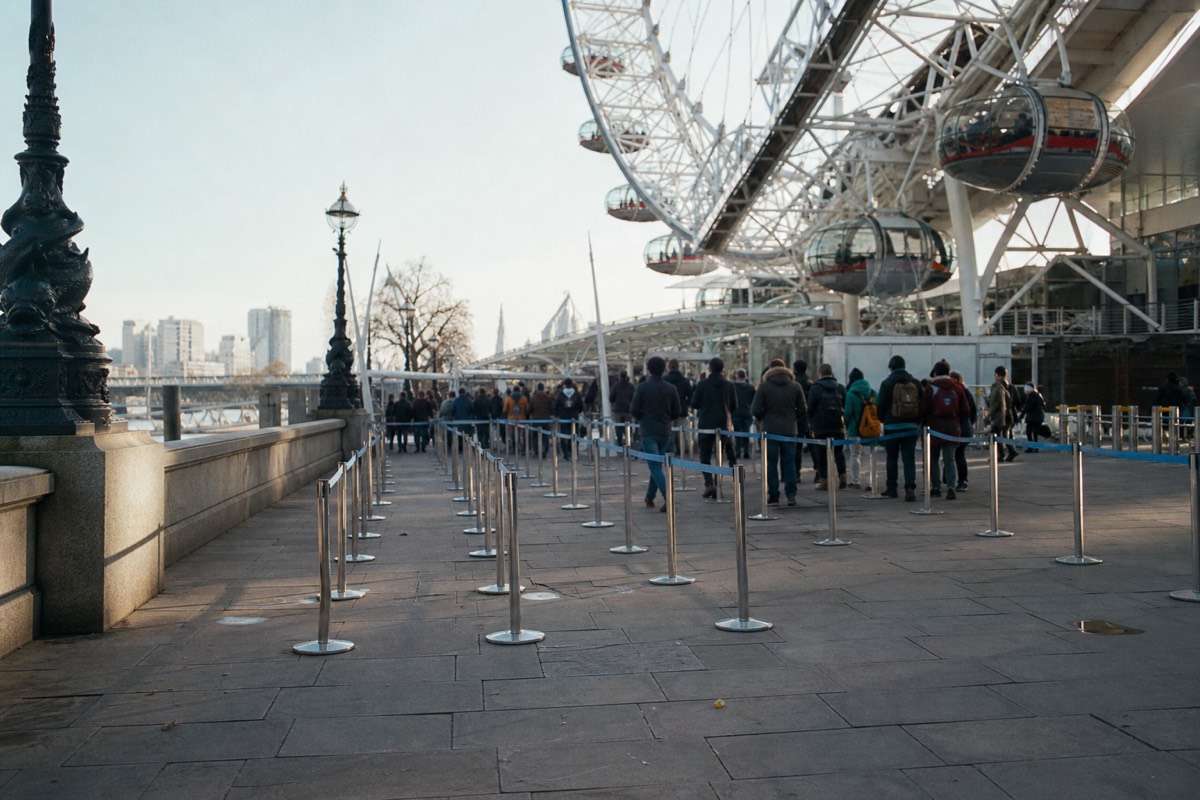
Short answer
Fast track skips the standard boarding queue; it does not change the ride. Its premium depends on the date and option. Compare it for busy dates or tight schedules; standard entry is the sensible starting point for a flexible visit.
The wheel can move about 1,600 people an hour when everything runs perfectly. It takes more than three million visitors a year. Those two numbers, held next to each other, are the entire fast track argument, and almost nobody selling a fast track ticket bothers to put them in the same sentence.
Fast track is not a better ride. The capsule, thirty-minute rotation and view are the same. You are buying priority boarding; decide whether the quoted premium is worthwhile for your own day.
What does London Eye fast track actually get you?
It skips the standard boarding queue. That is the whole product. The capsule, the rotation and the view are identical to standard entry. There is no separate viewing deck, no reserved space in the capsule, and no extended ride time. You use a priority boarding line, but security screening and some waiting remain.
This matters because the marketing around queue skipping at attractions has trained people to expect more. At some venues a priority ticket bundles in a lounge, a guide, or a better vantage point. Here it does not. The upgrade is purely about the minutes between arriving at the South Bank and stepping into a capsule.
There is one exception on this site, and it is a genuinely different product rather than a fast track tier: the champagne experience includes fast track priority boarding and adds a pre-boarding wait in the Eye Lounge. That is covered further down, because it changes the value calculation entirely.
Everything else on the ticket is identical across both tiers, and worth knowing before you decide the upgrade is what makes the visit. Either option puts you in a sealed, air conditioned capsule holding up to 25 people for a continuous 30 minute rotation, with glazing the whole way around so nobody is stuck facing the wrong way. The entry listing tracked here also includes a free downloadable companion guide app for the ride itself, on both options. Check the cancellation terms for the option you select.
That parity is the part the upsell language obscures. Priority entry at some attractions changes the experience itself. Here, once the doors close, standard and fast-track passengers have the same rotation.
The standard and fast track options also sit on the same listing tracked here. You are not choosing between two separate tickets on this site. You are choosing an option at checkout on one listing, which lets you compare the two options within the same booking flow.
How much more does fast track cost?
How long are the wait times for the London Eye?
Nobody publishes a live figure, and any page quoting you an exact number of minutes is guessing. What can be established honestly is the throughput arithmetic: the wheel moves about 1,600 passengers an hour at best, and takes over three million visitors a year, which averages more than eight thousand people a day.
Work that through and the shape of the day becomes visible. Eight thousand people at a ceiling of 1,600 an hour is more than five hours of running at absolute full capacity, on an average day, before you account for the fact that demand is not spread evenly across opening hours. Nobody arrives at 10:40 on a Tuesday in equal numbers to 18:00 on a Saturday in August.
That uneven distribution is what creates a queue at all. The wheel does not slow down when more people arrive. It turns at about 0.9 kilometres an hour regardless, boarding continuously, carrying up to 25 people per capsule across 32 capsules. Demand above the ceiling has nowhere to go except into a line on the pavement.
The useful answer is a planning judgment: busy periods can produce longer queues, while quieter slots can reduce the benefit of fast track. No ticket comparison can promise the number of minutes you will save.
Who should pay extra for fast track?
Anyone visiting on a summer weekend, during school holidays, over a bank holiday, or in the two hours before sunset. Anyone with a fixed booking afterwards, a theatre curtain, a dinner reservation, a train home. Anyone with small children or limited mobility for whom standing in an outdoor line is the hard part, not the cost.
The strongest case is the timed commitment. If you have a table booked at seven and a wheel slot at half five, a queue you cannot predict is a risk to the evening, not merely an annoyance. Priority boarding can reduce the queue, but it does not remove timing risk; leave a buffer before a fixed commitment.
The second case is daylight. If sunset matters to your plans, compare a suitable slot with the extra cost of priority boarding. Demand and waiting times vary; allow a buffer rather than assuming a fixed time saving.
The third case is physical rather than financial. The standard queue is largely outdoors along the South Bank, exposed to whatever London is doing that afternoon. For a family with a toddler, a visitor with a mobility limitation, or anyone who simply cannot stand for a long stretch, check the operator’s accessible boarding arrangements before paying for fast track; a paid upgrade does not replace an access reservation.
There is a fourth, quieter case: a single day in London. If the wheel is one of four things on a compressed one day itinerary, every minute you lose to a queue is taken from something else you flew in to see. Under that constraint, a shorter queue may be worth paying for, but no specific time saving is guaranteed.
Who should skip fast track and take the standard queue?
Anyone visiting off peak, on a weekday outside school holidays, in the first hour after opening or in winter. Anyone with an open ended afternoon and no fixed commitment afterwards. Anyone travelling as a group of four or more, where the premium compounds into real money.
The off-peak case is straightforward: a quiet weekday may produce a shorter standard queue, reducing the benefit of priority boarding. Compare the quoted upgrade price with the time pressure on your actual day.
Group size compounds the upgrade cost. Multiply the quoted premium by your paying passengers and compare it with what the same budget could buy elsewhere in your day.
Flexibility is the third case. If nothing is booked after the wheel, a queue is a wait, not a problem. Waiting on the South Bank with a coffee, watching the river, is not the worst hour London can give you. That is a genuinely different experience from waiting there with a taxi booked.
There is also a route that sidesteps this argument entirely for some visitors. If you are travelling into London by train, the National Rail day out offer attaches a discount to attraction entry for passengers holding a valid train ticket, with conditions including advance booking. It is a separate scheme from anything sold here, and the honest breakdown of how it works is worth reading before you assume it stacks with anything else.
When are the queues at their shortest?
Early weekday and off-season slots are reasonable options to compare when avoiding crowds matters. They are planning choices, not guarantees of a short queue; actual waiting depends on the day.
Compare the first available slot of the day if it fits your plans. Starting early may help avoid later crowds, but check that date’s opening hours and leave time for boarding and security.
Winter can suit visitors who prefer earlier dusk and an enclosed capsule. Check operating dates and hours before planning around a winter visit; quieter demand does not guarantee immediate boarding.
| Time of visit | Planning consideration |
|---|---|
| Early weekday or off-season slot | Compare standard entry first if your schedule is flexible |
| Weekend or school-holiday visit | Allow extra time; compare priority entry if timing matters |
| Sunset visit | Choose around the actual sunset and operating hours; leave a queue buffer |
| First slot of the day | Check the date’s opening time; waiting is still possible |
Weather affects both the view and the appeal of an outdoor wait. A clear forecast may improve the skyline experience, while rain can reduce visibility. Do not assume a forecast proves how long the queue will be.
Compare nearby time slots before buying an upgrade. A different slot may suit your budget or itinerary better, but a lower price does not establish a shorter queue.
Which tickets tracked here include priority boarding?
Two of the five. The single entry listing covers both standard and fast track, chosen at checkout. The champagne experience includes fast track priority boarding as part of the package. The three combo tickets bundle other attractions rather than queue position, so treat them as standard entry unless the listing says otherwise.
That distinction is worth checking before you buy a bundle expecting to walk past the line. The combos are built around covering more attractions for less money, not around getting you onto the wheel faster. The three attraction ticket gives you a timed Madame Tussauds entry booked at the point of purchase, with wheel and SEA LIFE admission redeemed by voucher within 7 days of the first visit. Reserve each attraction through the voucher instructions.
The widest bundle stacks wheel admission and a one way Thames river cruise onto a 24 or 48 hour hop on hop off bus pass across three routes, with live tracking, audio commentary and free onboard Wi-Fi. Check the option-specific inclusions and current combo price on the listing.
| Ticket | What the extra purchase buys |
|---|---|
| Standard or fast-track entry | One rotation; priority boarding only when selected |
| Champagne experience | Shared rotation, priority boarding, host and champagne |
| SEA LIFE and wheel | Admission to both attractions |
| Madame Tussauds, wheel and SEA LIFE | All three admissions; reserve visits within the voucher window |
| Wheel, cruise and bus | Eye entry, one-way river cruise and selected bus pass |
How does the champagne experience compare with a plain fast track ticket?
The champagne option includes fast track priority boarding, so it is a superset of a fast track ticket rather than a rival to it. On top of the queue skip it adds an exclusive pre boarding wait in the Eye Lounge, a personal host, and a glass of chilled Moet & Chandon Imperial Brut Champagne on the standard 30 minute rotation.
If you were already leaning toward fast track for an occasion, this is the comparison to run. You are not choosing between a queue skip and a drink. You are choosing between a queue skip alone, and a queue skip plus an indoor lounge wait, a host, and real champagne rather than prosecco. The listing is specific that it is genuine champagne, which is a detail that gets fudged elsewhere often enough to be worth stating.
Its price depends on the date and party; compare the hosted experience with the ordinary fast-track option. Availability depends on the date and option selected. The selected option’s cancellation terms and deadline apply.
The Eye Lounge adds an indoor pre-boarding stage to the champagne experience. That can be a useful occasion extra, but it does not guarantee every part of the wait is indoors or remove security screening.
So which option should you actually book?
Start with standard online entry for a flexible visit. Compare fast track for a busy date or tight schedule, and champagne if you want the hosted occasion upgrade. For access needs, arrange the operator’s access process rather than assuming a paid upgrade is required.
Run the decision in that order and you will rarely get it wrong. Start from standard, because it is the cheaper default and it is genuinely sufficient most of the year. Move up only when you can name the reason. "It might be busy" is not a reason. "We have a table at seven and it is a Saturday in August" is.
At the official standard starting prices, booking online is £29 against £39 walk-up. Check the quote for your own date, and avoid paying for priority boarding unless its benefit matters to you.
One last piece of context on why the queue exists at all. The wheel is no longer a temporary structure waiting on a decision: Lambeth councillors voted unanimously in May 2024 to make it permanent, a decision the operator announced in its own press release on the London Eye becoming permanent. Permanent status means the demand that produces these queues is not going anywhere either, and the throughput ceiling is fixed by the engineering.
If you want the full price picture across every tier and bundle before committing, the 2026 price breakdown sets the four entry prices against the combo options side by side. For the story behind the wheel itself, including why it is still called the Millennium Wheel, the name and facts guide covers it properly.
Common questions about fast track on the wheel
What does London Eye fast track include?
It skips the standard boarding queue and nothing else. The capsule, the 30 minute rotation and the view are identical to standard entry. There is no separate deck, no reserved capsule space and no longer ride. The only ticket tracked here that adds more is the champagne experience, which includes priority boarding plus an indoor pre boarding lounge.
How long are the wait times for the London Eye?
Waiting varies with demand and operations. Throughput gives context, but annual visitor totals cannot predict the queue for your slot. Allow time for boarding and security even with priority entry.
Is fast track worth it at the London Eye?
Compare it on busy dates or when your schedule is tight. On a flexible visit, standard entry may be sufficient. Multiply the actual upgrade price by your party size, and do not assume a guaranteed time saving.
Can you buy fast track at the London Eye on the day?
Check the available options for that date. The operator lists online and walk-up pricing, but ticket type and remaining slots matter; a walk-up visit cannot guarantee the time you wanted.
What is the cheapest way to visit the London Eye?
Start by comparing standard adult entry booked online, currently from £29 on the official page. Check your date, any offer you qualify for and the final total before paying for extras.
Choose Your London Eye Experience
Set your London Eye slot before your next timed booking. Compare standard and fast-track options for your actual date, then pay for priority only if it serves your day.
London Eye Standard or Fast Track Ticket. A 30-minute rotation. Choose standard or fast-track boarding; security and some waiting remain. Reserve the dated option that suits your party.
Tailor Your Ticket Choice And Compare Costs
- London Eye Champagne Experience: A shared-capsule 30-minute ride with fast-track entrance, an English host, Eye Lounge access and a glass of champagne for adults aged 18+. Security screening still applies.
- London Eye Private Capsule Experience for Couples or Groups: Exclusive 30-minute London Eye capsule with fast-track entrance. This reviewed listing is for guests aged 18+ with at least two adults; select the group or couple option. Do not assume drinks or a host are included.
Choose dates directly on GetYourGuide
Confirm your visit date on the booking page before payment.