Getting to the London Eye: Tube, Train, Bus and River, Step by Step
County Hall, SE1 7PB, on the South Bank at Jubilee Gardens, directly opposite the Houses of Parliament. Here is every sensible way to reach it.
Short answer
The London Eye is at County Hall, Westminster Bridge Road, London SE1 7PB, on the South Bank at Jubilee Gardens. Waterloo is the nearest station at about a five-minute walk. Westminster, Embankment and Charing Cross are 10 to 15 minutes away and involve crossing a bridge.
Almost nobody arrives at the London Eye from the direction they expect. It looks like it belongs to Westminster, because it stands directly across the water from the Houses of Parliament, but it is on the opposite bank in the London Borough of Lambeth. The full address is the Riverside Building, County Hall, Westminster Bridge Road, London SE1 7PB, and the wheel itself stands in Jubilee Gardens at roughly 51.5033 north, 0.1195 west. If you are aiming for Big Ben on your map, you are aiming at the wrong side of the river.
Where exactly is the London Eye?
On the South Bank of the Thames at Jubilee Gardens, attached to the County Hall complex, directly opposite the Palace of Westminster and Big Ben. The postcode is SE1 7PB. The nearest major transport hub is Waterloo, about five minutes on foot.
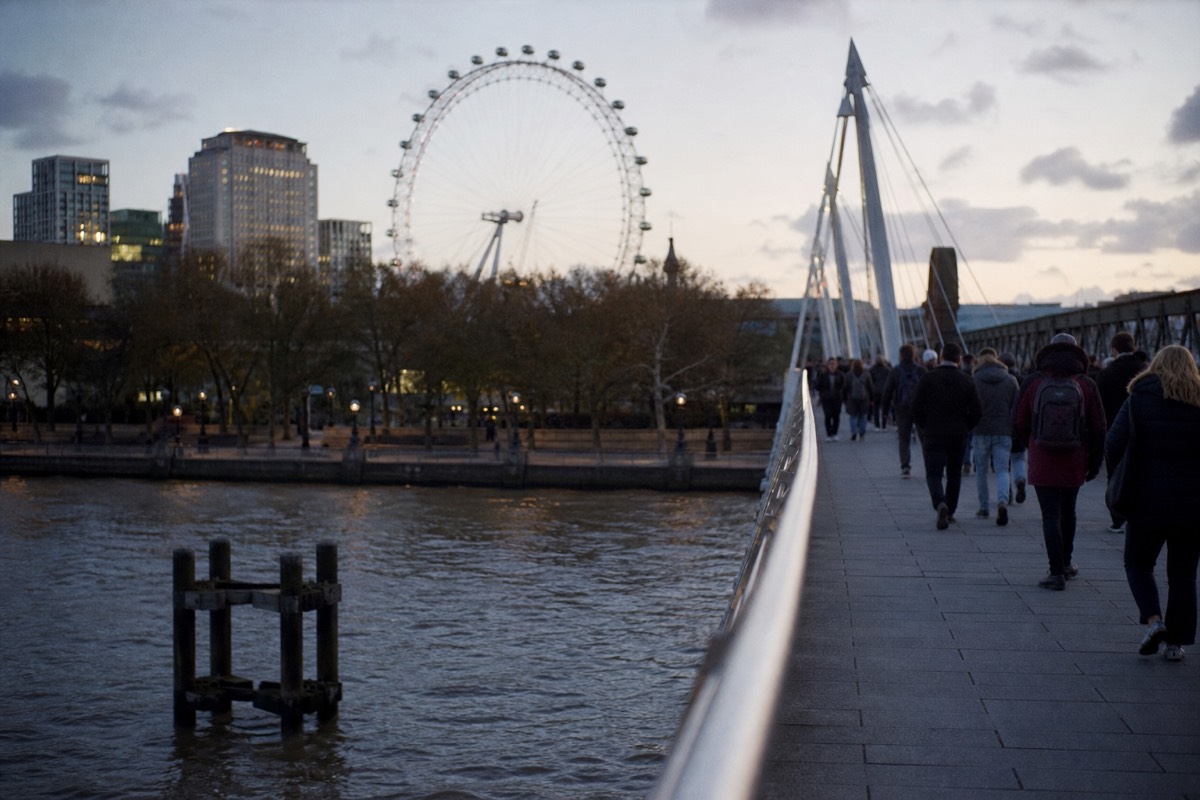
The riverside walkway that runs past the boarding platform is the Queen's Walk, and it links the whole South Bank cultural strip in a continuous line. That geography is the useful part to hold in your head: you are on a pedestrian promenade, not a road, and every approach ends with a short walk along the river regardless of how you travel.
| Detail | |
|---|---|
| Full address | Riverside Building, County Hall, Westminster Bridge Road, London SE1 7PB |
| Coordinates | 51.5033 north, 0.1195 west |
| Setting | Jubilee Gardens, on the Queen's Walk, South Bank |
| Directly opposite | The Houses of Parliament and Big Ben, across the Thames |
| Borough | Lambeth |
| Nearest station | Waterloo, about a five-minute walk |
| River pier | London Eye Pier, on the Queen's Walk |
The County Hall connection also explains the other attractions in the immediate area. The building beneath and beside the wheel houses the SEA LIFE London Aquarium and other Merlin attractions, which is why combined tickets for the South Bank cluster exist at all and why a family can move between two of them without touching public transport.
What is the nearest tube station to the London Eye?
Waterloo, on the Bakerloo, Jubilee, Northern and Waterloo and City lines, roughly five minutes' walk and on the same side of the river. Westminster, Embankment and Charing Cross are all 10 to 15 minutes away and require crossing a bridge.
The London Eye's official directions page is the source worth trusting here, because plenty of third-party sites quote optimistic walking times that assume you already know which exit to use.
| Station | Walk | Which side | What you cross |
|---|---|---|---|
| Waterloo | About 5 minutes | Same side as the wheel | Nothing, follow signs for the South Bank |
| Westminster | 10 to 15 minutes | North side | Westminster Bridge |
| Embankment | 10 to 15 minutes | North side | Hungerford Bridge |
| Charing Cross | 10 to 15 minutes | North side | Hungerford Bridge |
Waterloo wins on more than distance. It is the only one of the four that does not put a bridge and a set of steps between you and the boarding platform, which matters with luggage, a buggy or a wheelchair. It also happens to be one of the largest transport interchanges in the country: Waterloo handled 70.39 million entries and exits in 2024 and 2025, has 24 platforms, more than any other station in the UK, and is the largest British station by floor space.
That size is also its one drawback. A station with 24 platforms and multiple exits is easy to leave from the wrong end, which turns a five-minute walk into fifteen. The fix is knowing which way out to take before you arrive.
How do you walk from Waterloo to the London Eye?
Follow the Southbank signs out of the main building, cross York Road, walk through Southbank Place, then cross Belvedere Road into Jubilee Gardens. The wheel is in front of you. From the exit closest to the South Bank the walk is roughly 300 metres; the step-free route runs about 600 metres.
Broken down properly, because this is the journey most visitors make:
- From the main concourse, follow the Southbank signage. Waterloo signposts it internally. Ignore anything pointing towards Waterloo Road or the Old Vic; those lead inland, away from the river.
- Leave by the exit nearest the South Bank. The access guide for the Waterloo to Queen's Walk route puts that exit around 300 metres from the gardens, down a flight of stairs. If you need step-free access, use the exit onto Station Approach instead, which is longer at around 600 metres but has no steps.
- Cross York Road. This is the only real road crossing on the walk, and it puts you on the river side of the station.
- Walk through Southbank Place. The pedestrianised stretch runs about 120 metres and is step-free the whole way.
- Cross Belvedere Road into Jubilee Gardens. That crossing is level with the road with tactile paving on both sides, and there is no signalised pedestrian crossing at that point, so look before you step out.
- Head for the riverside edge. The wheel stands in Jubilee Gardens with boarding along the Queen's Walk. Check your ticket for which point to report to, since standard, fast-track and upgraded tickets do not all use the same queue.
Five minutes is realistic if you leave from the correct side. Allow ten if you arrive on a mainline service at a busy hour, and more with children, given the York Road crossing and the unmarked one at Belvedere Road.
Waterloo East, which sits alongside the main station and serves different rail routes, connects through a covered walkway to the main concourse, so the same directions apply once you are inside.
Which buses stop near the London Eye?
A lot of them. The London Eye's official directions list routes 1, 12, 59, 68, 76, 77, 139, 148, 159, 168, 176, 188, 211, 243 and 381 among the services running within walking distance, mostly along Waterloo Road, York Road and Westminster Bridge Road. Route numbers around Waterloo have changed more than once in recent years, so check the stop before relying on one.
Buses are the underrated way to arrive, for one specific reason: they cross the bridges. A route running over Westminster Bridge or Waterloo Bridge gives you the approach view of the wheel that tube passengers never see, and the fare is a fraction of an off-peak tube journey. London buses have been cash free since July 2014, so you tap a contactless card, a phone or an Oyster card as you board, and daily capping is applied for you.
The catch is traffic. Westminster Bridge Road and the Waterloo roundabout are among the slower stretches of central London, and a bus that looks quick on a map can take twice as long as walking from Waterloo. If your slot is close, the tube is the safer choice.
For sightseeing rather than transport, the hop-on hop-off pass changes the calculation completely. The bundle tracked here puts London Eye admission together with a 24-hour or 48-hour Big Bus pass over three routes and a one-way Thames cruise, so the journey and the attractions come from the same ticket. That combination is picked apart in the river cruise and bus combo guide.
Can you get to the London Eye by boat?
Yes, and it is the most enjoyable arrival of the lot. London Eye Pier sits on the Queen's Walk, a few steps from the boarding platform, and is served by the RB1 river bus route. It is also listed under the names Waterloo Pier and London Eye Millennium Pier.
The pier's own page sets out the pattern clearly, and there is one quirk worth knowing before you plan a journey around it. Eastbound sailings call here directly; check the current timetable for your travel date and direction. Travelling westbound, you stay on board: the boat turns around at Westminster Pier and then calls at London Eye. If your service terminates at Battersea Power Station instead, the advice is to get off at Westminster Pier and cross Westminster Bridge on foot.
| Coming from | How it works |
|---|---|
| Tower, London Bridge or Bankside | Westbound journey; check whether your service reaches London Eye via Westminster |
| Greenwich or Canary Wharf | A long, scenic run up the river with several changes of scene |
| The O2 or North Greenwich | The full length of the central and east river service |
| Westminster Pier | One stop, or a five-minute walk across Westminster Bridge |
| Embankment or Blackfriars | Short hop across and along the river |
The London Eye also runs its own 40-minute circular Thames cruise from the same pier, which is a different product from the river bus: a sightseeing loop rather than transport between two points.
Arriving by boat has a practical advantage beyond the view. The pier is inside the same riverside complex as the wheel, so the walk from gangway to queue is measured in seconds, and there are no stairs down from a bridge to negotiate.
Should you drive, or take a taxi?
Driving is the weakest option. The London Eye sits inside the Congestion Charge Zone, there is no visitor car park attached to the attraction, and the surrounding streets are heavily restricted. Taxis and ride-hailing drop off nearby but not at the wheel itself.
| Arriving by car | What to expect |
|---|---|
| Congestion Charge | The attraction is inside the zone, and the daily charge applies during charging hours |
| Parking | No attraction car park; Q-Park Westminster is the option the official site points to, with a discount on pre-booked stays |
| Coach drop-off | Permitted, with a 15-minute limit |
| Taxi and ride-hail | Drop-off is on the surrounding roads rather than at the boarding platform, followed by a short walk |
| Accessible parking | Limited on-street provision nearby; check the official accessibility guide before travelling |
Pre-booking a parking space is the difference between a manageable arrival and circling Lambeth for twenty minutes. Even then, the combination of the daily charge and central London parking rates usually costs more than four tube fares.
There is one situation where a car genuinely helps: travelling with a wheelchair user or someone with limited mobility who cannot manage a bridge or a long concourse. In that case the drop-off on Belvedere Road is close, and the wheel itself is well set up for the rest, with step-free boarding and the ability to slow the rotation to a near-stop while people get on and off.
Is the route to the London Eye step-free?
Yes, if you plan it. Waterloo has a step-free exit onto Station Approach, the walk through Southbank Place is pedestrianised and level, and boarding at the wheel itself is step-free, with the rotation slowed to a near-stop while people get on and off.
The step-free route from Waterloo is longer than the quickest one, around 600 metres rather than 300, because it avoids a flight of stairs. That trade is usually worth taking: the shorter exit involves steps down and then a road crossing, while the longer one runs on the flat the whole way. The one point to watch is the crossing over Belvedere Road into Jubilee Gardens, which is level with the road and marked with tactile paving on both sides but has no signalised crossing.
From the north bank, check the step-free route for the specific bridge and station exit you intend to use. River arrival ends beside the attraction, but pier access and boarding arrangements also need checking for your mobility requirements.
At the attraction, the picture is better than the structure suggests. Boarding is step-free and staff can assist, but wheelchair capacity and mobility-scooter suitability need checking before visiting. Carer tickets are available with qualifying documentation. The official site also publishes sensory and social-story guides, which are genuinely useful for anyone who wants to know the exact sequence of what happens before they arrive. Buggies may be taken into the capsules if folded before joining the boarding queue and kept folded until you have left the attraction; free buggy storage is also available.
How early should you arrive for your slot?
For standard entry, join Entrance A at the time on your ticket; fast-track visitors use Entrance F at their booked time. Allow time beforehand to walk from the station. Champagne Experience guests check in at the VIP desk at least 15 minutes before their slot.
The ticket time marks when you join the queue, not the moment your capsule departs. Leave a sensible travel buffer, but follow the meeting instructions on your own ticket rather than assuming early admission or a late-arrival grace period.
Three practical points about the arrival itself:
- Queues differ by ticket type. Standard, fast-track and the Champagne Experience report to different points, and the Champagne Experience checks in at the VIP desk before the Eye Lounge visit.
- Queue length varies. Allow extra time on busy dates; an early slot does not guarantee faster boarding.
- Weather can pause the wheel. High winds may interrupt operations. Check your ticket’s cancellation deadline and the operator’s disruption instructions.
If you are still choosing between a standard slot and a fast-track one, the queue-time comparison is set out in the fast track versus standard ticket guide, and the case for booking early in the day is made in the opening times and best time to visit guide.
What is the best route for your situation?
Coming from a mainline terminal, get to Waterloo. Staying in Westminster or Mayfair, walk across the bridge. Arriving with luggage, take a taxi to Belvedere Road. Making a day of it on the river, take the boat.
| Starting from | Best route | Roughly |
|---|---|---|
| Waterloo or Waterloo East | Walk, following South Bank signs | 5 minutes |
| Westminster area | Walk across Westminster Bridge | 10 to 15 minutes |
| Trafalgar Square or the Strand | Walk over Hungerford Bridge from Charing Cross or Embankment | 10 to 15 minutes |
| Tower Bridge or London Bridge | River bus to London Eye Pier | A scenic half hour |
| Anywhere on the tube network | Change for Waterloo on the Bakerloo, Jubilee, Northern or Waterloo and City line | Varies |
| Arriving with heavy luggage | Taxi to Belvedere Road, then a short walk | Varies with traffic |
Book an available slot before fixing your journey: it is easier to plan transport around a queue-entry time. Cancellation deadlines depend on the selected ticket. You can also check the official site's current prices here. If you are still weighing whether the trip is worth making at all, the guide on whether the London Eye is worth it sets out the tradeoffs.
What else do people ask about getting there?
What is the nearest station to the London Eye?
Waterloo, about five minutes on foot and on the same side of the river. It serves the Bakerloo, Jubilee, Northern and Waterloo and City underground lines plus mainline rail, and Waterloo East sits alongside it. Westminster, Embankment and Charing Cross are all 10 to 15 minutes away with a bridge to cross.
How long does it take to walk from Waterloo to the London Eye?
About five minutes if you leave by the South Bank exit towards York Road and Belvedere Road. Allow ten if you arrive at a busy hour or with children, since a wrong exit from a 24-platform station can easily add another ten minutes to the walk.
Can you get to the London Eye by boat?
Yes. London Eye Pier, also listed as Waterloo Pier, sits on the Queen's Walk beside the attraction and is served by the RB1 river bus route. Eastbound sailings call directly; westbound passengers stay on board past Westminster Pier and are brought back to the pier.
Is there parking at the London Eye?
No attraction car park. The site sits inside the Congestion Charge Zone, and the official directions point drivers to Q-Park Westminster, which offers a discount on pre-booked stays. Coach drop-off is allowed with a 15-minute limit. Public transport is faster and cheaper in almost every case.
How early should you get there before your time slot?
Join the standard or fast-track queue at your booked time, allowing travel time beforehand. Champagne Experience guests check in at the VIP desk at least 15 minutes before their slot.
Choose Your London Eye Experience
Choose your visit date before fixing the rest of your London plans, then check the ticket option and queue-entry time.
London Eye Standard or Fast Track Ticket. A 30-minute rotation. Choose standard or fast-track boarding; security and some waiting remain. Reserve the dated option that suits your party.
Tailor Your Ticket Choice And Compare Costs
- London Eye, Thames Cruise & Hop-on Hop-off Bus: London Eye admission, a 24- or 48-hour Big Bus pass and a one-way City Cruises journey between Westminster and Tower Pier. Reserve the Eye separately; this is not the circular Eye River Cruise.
- SEA LIFE London + London Eye Combo: SEA LIFE and standard London Eye entry. The initial slot is for SEA LIFE; reserve the Eye separately with your voucher. Transport and food are extra.
- London Eye River Cruise, with Optional London Eye Ticket: An approximately 40-minute circular cruise from London Eye Pier, with English commentary and covered or open seating. Eye admission is included only if you select the combined option.
Choose dates directly on GetYourGuide
Confirm your visit date on the booking page before payment.